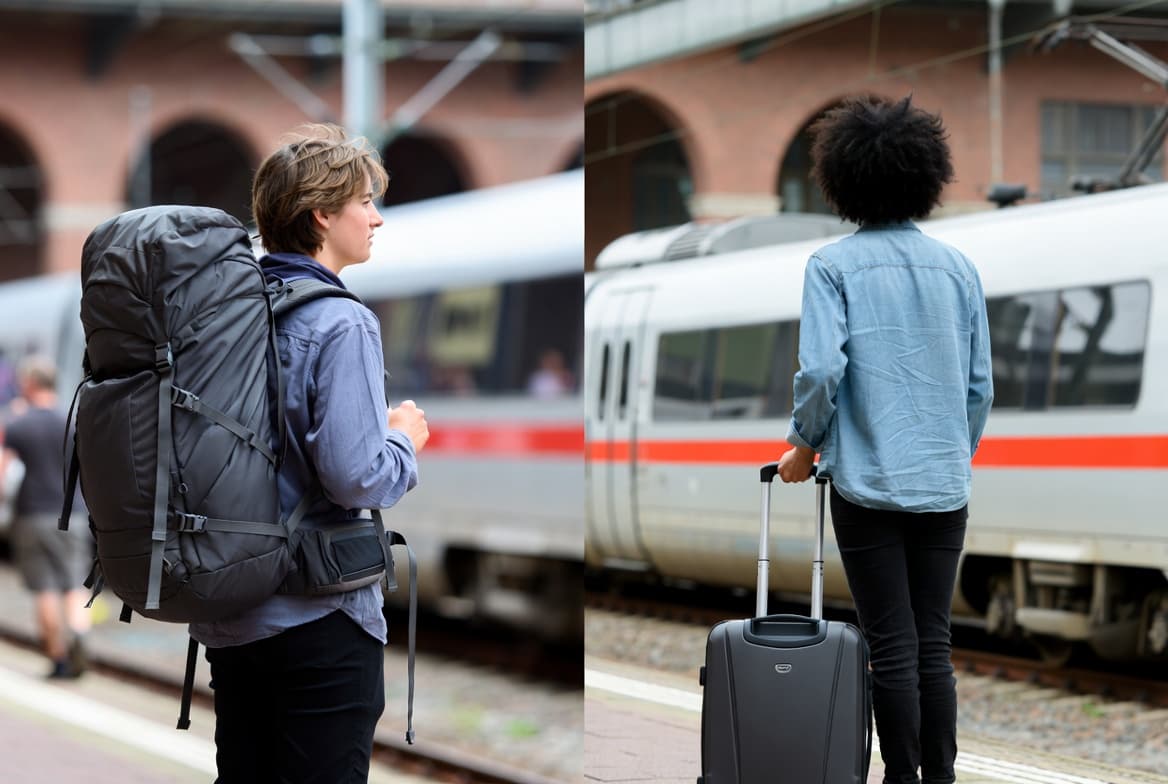
Interrail luggage guide

Backpack or Suitcase for Interrail? How to Choose the Best Luggage

For most Interrail trips with several stops, a carry-on-size backpack is easier. A suitcase can still be the right call if you need wheels, have smoother transfers, or know your back will hate the whole idea.

Updated June 5, 2026Backpack vs suitcaseEuropean train luggage
Best default
35-45L backpack

For most multi-stop Interrail trips, a carry-on-size backpack is the least awkward main bag.

Best comfort choice
Carry-on suitcase

Choose wheels if carrying weight on your back would be painful, unsafe, or simply miserable.

Best compromise
One main bag + daypack

Keep valuables, passport, medicine, water, and train snacks in a small bag that stays with you.

Quick Answer

Choose a backpack unless your body or route says suitcase

If you are changing cities often, staying in hostels, using metros, walking from stations, or visiting older European city centres, choose a compact backpack. If you have pain, heavier equipment, smooth transfers, or accommodation with lifts, choose a carry-on suitcase and keep valuables in a small daypack.

Reasons to choose a backpack

  • Easier to carry up station stairs, hostel stairs, bridges, and metro steps.
  • Handles cobblestones, cracked pavements, gravel, curbs, and old-town streets without dragging wheels.
  • Leaves both hands free for doors, tickets, maps, phones, handrails, coffee, or a quick platform change.
  • Less awkward when boarding trains with narrow doors, high steps, or crowded vestibules.
  • Usually lighter when empty than a wheeled suitcase of similar size.
  • Soft sides can squeeze into overhead racks, between seats, under seats, or into odd luggage gaps.
  • Can stay closer to your body when moving through busy stations and city streets.
  • Reduces the chance that your main bag has to sit in a distant end-of-carriage luggage rack.
  • Better for hostels, budget apartments, and older buildings where lifts are missing or unreliable.
  • Makes short train changes and station transfers less stressful.
  • Encourages lighter packing because you feel the weight immediately.
  • Side pockets and top pockets can make small items easier to grab during travel days.
  • Works well with packing cubes, especially if the backpack opens from the front like a suitcase.
  • Can be easier on routes that include budget flights, buses, ferries, or long walks to accommodation.

Reasons to choose a suitcase

  • Keeps the main weight off your back, shoulders, and hips.
  • Much easier if you have an injury, disability, chronic pain, or simply dislike carrying loads.
  • Rolls smoothly through modern stations, airports, hotel lobbies, and level pavements.
  • Opens flat, making clothes, shoes, toiletries, and packing cubes easier to see.
  • Hard-shell models protect fragile items better than most soft backpacks.
  • Structured sides reduce crushed clothing and can feel tidier for longer trips.
  • A small daypack can sit on top of the handle on smooth surfaces.
  • Works well for trips with fewer stops, longer stays, hotels, apartments, and lifts.
  • Can be easier when you need to pack formal clothing, a laptop setup, medical gear, or extra shoes.
  • A carry-on suitcase can fit many train luggage racks if you keep it small and light enough to lift.
  • Wheels help on long, flat concourses where a backpack would tire your shoulders.
  • You can stand it upright beside you while waiting in queues or on platforms.
Tradeoffs

The annoying parts matter too

The best luggage choice is not the one with the longest pros list. It is the one whose downsides you can tolerate on your actual route.

Backpack downsides

  • Weight sits on your body, so it can be wrong for back, neck, shoulder, knee, or balance issues.
  • A poorly fitted backpack can make even a light load uncomfortable.
  • Top-loading hiking packs can be annoying when you need one item at the bottom.
  • Large trekking backpacks can be too tall or bulky for racks, lockers, and airline carry-on rules.
  • Your back can get hot in summer, especially while walking between stations and hostels.
  • Soft fabric protects fragile souvenirs less than a hard-shell suitcase.
  • Loose straps need to be tucked away so they do not snag in train aisles or luggage racks.

Suitcase downsides

  • You still have to lift it onto trains, into racks, up stairs, and across gaps.
  • Wheels struggle on cobblestones, gravel, uneven pavements, and stepped streets.
  • Large suitcases may need end-of-carriage racks, which can be out of sight from your seat.
  • Hard-shell cases are less flexible when overhead racks or lockers are tight.
  • Wheels and handles add empty weight and reduce usable internal space.
  • One hand is usually occupied while moving.
  • Spinner wheels are easy on smooth floors but more exposed on rough streets.
  • A large suitcase makes rushed platform changes much more stressful.
  • Some operators have size or number limits, especially high-speed and low-cost services.
Decision Table

Backpack or suitcase: what should you choose?

Use this as the simple decision layer before you buy anything. A cheap bag you already own can beat a perfect new bag if it matches the route.

Your Interrail situationBetter pickWhy
Many cities, short stays, hostels, and spontaneous plansBackpackYou will carry your bag often, and mobility matters more than perfect organization.
Hotels, apartments, lifts, taxis, and fewer transfersSuitcaseThe trip gives your wheels enough smooth ground to be useful.
Back pain, shoulder pain, injury, balance issues, or heavy medicationSuitcaseReducing body load is more important than speed on stairs.
Paris metro transfers, old Italian towns, hilly streets, or stations without liftsBackpackStairs and rough streets are where backpacks earn their keep.
You want to keep your main bag near your seatBackpackA soft bag is more likely to fit overhead, between seats, or under a seat.
You need fragile-item protection or very structured packingSuitcaseA hard or semi-rigid case protects and organizes better.
You are likely to fly within Europe during the same tripEither, but carry-on sizeAirline size and weight rules can matter more than the train bag decision.
You already own a good carry-on suitcase and a small backpackUse what you ownA small suitcase plus daypack is a strong setup if you keep transfers realistic.
Train Rules

European train luggage rules are generous, but not unlimited

Interrail itself is not the luggage operator. The train company rules matter, and they often share one theme: bring luggage you can carry yourself and store without blocking other passengers.

Interrail

Interrail says your luggage does not need to be a backpack, but you should pack light because you carry bags on and off trains yourself.

The pass does not force the choice. Your route and body do.

Check the source

Eurostar

Standard and Plus travellers can usually take two luggage pieces plus one hand-luggage item, with maximum length rules and no general weight limit if you can carry and stow the bags safely.

Suitcases and backpacks both work, but oversize bags can become a paid problem.

Check the source

SNCF TGV INOUI

SNCF lists size limits for labelled suitcases, large backpacks, hiking bags, and hand luggage, and says to travel only with things you can carry yourself.

A huge bag is not just annoying. On some French trains it may breach the rule.

Check the source

Deutsche Bahn

DB allows backpacks, suitcases, and similar luggage free of charge, but larger pieces may need racks away from your seat and must be supervised by you.

Smaller bags are easier to keep close and easier to stow independently.

Check the source

SBB

SBB says the easiest and most secure place is between or under seats when possible, with overhead racks for smaller items such as backpacks and handbags.

A compact bag has a real security and convenience advantage.

Check the source

Trenitalia

Trenitalia allows easily transportable luggage if it is placed in dedicated spaces and does not obstruct passengers, staff, or the train.

Italy is suitcase-friendly on many trains, but city streets and station stairs can still decide.

Check the source
Packing Setup

The best Interrail luggage setup is one main bag and one daypack

Do not turn the decision into a shopping spiral. A small main bag plus a daypack solves more problems than a huge premium bag.

Pack for the carry, not the calendar

A two-week and six-week Interrail trip can use almost the same bag if you do laundry. Extra days should add washing rhythm, not endless outfits.

Keep valuables in the daypack

Passport, wallet, phone, keys, medicine, laptop, and chargers should stay with you, not in a distant luggage rack.

Check flights before bags

If your route includes budget flights, the strictest airline rule may matter more than generous train luggage space.

Test the station walk

Before leaving home, carry or roll the packed bag for 15 minutes and lift it above shoulder height. That tells the truth fast.

FAQ

Backpack or suitcase for Interrail: quick answers

Is a backpack or suitcase better for Interrail?

For most fast-moving Interrail trips, a carry-on-size backpack is easier because it handles stairs, cobblestones, crowded platforms, hostels, and tight transfers better. A carry-on suitcase is better if carrying weight on your back would be painful or unsafe.

Can you take a suitcase on Interrail trains?

Yes. Interrail luggage does not have to be a backpack. Many European train operators accept suitcases, but you usually need to carry, label, supervise, and stow your own luggage without blocking aisles, doors, or safety equipment.

What size backpack is best for Interrail?

A 35 to 45 litre front-opening backpack is a practical target for many summer Interrail trips if you can do laundry. A 45 to 55 litre bag can work for colder weather, but large hiking packs quickly become harder to lift, store, and carry.

What suitcase size is best for Interrail?

Choose a carry-on-size suitcase you can lift into a rack and carry up stairs yourself. A large checked-size suitcase is only sensible for slower trips with short transfers, hotels with lifts, and fewer train changes.

Is a suitcase safe on European trains?

It can be, but you should keep valuables in a small bag with you. Larger suitcases often go in racks by the doors or carriage ends, so label the bag, avoid leaving valuables inside, and choose a seat where you can see it when possible.

Is a wheeled backpack a good Interrail compromise?

Sometimes. A wheeled backpack gives flexibility, but wheels and handles add weight and reduce packing space. It works best if you truly need both modes and can accept that it is usually heavier than a normal backpack.

Final recommendation

Pick the bag that makes your hardest travel day easier

If your hardest day is stairs, walking, and tight train changes, take the backpack. If your hardest day is physical strain from carrying weight, take the suitcase. Either way, keep it carry-on sized and light enough to lift yourself.

Backpack for movement, stairs, hostels, and rough streets.

Suitcase for comfort, structure, and smoother trips.